
Spray tanning is based on the use of dihydroxyacetone (DHA), an accidental discovery dating back to the 1920s. DHA is a simple sugar derived from sugar cane or sugar beet. However, it was not until the mid-1950s that its tanning properties were fully discovered.
Discovery of the “Maillard Reaction”
The DHA reaction — DHA is in fact a simple sugar — was extensively described in the 1920s by Louis Maillard in France. Although he was not studying tanning, his research focused on the colour of beer, toasted bread and cooked meats, and why these products became brown when prepared. Maillard eventually determined that the brown colour was caused by a reaction between proteins and sugars in food. This is the “Maillard reaction” that we commonly refer to today.
The Work of Dr. Eva Wittgenstein
The story really begins with research conducted by Dr. Eva Wittgenstein, a researcher at the University of Cincinnati. In the 1950s, she was working with DHA as part of treatments for metabolic diseases.
In the 1950s, at the University of Cincinnati Children's Hospital, researcher Eva Wittgenstein began administering high oral doses of DHA to children suffering from a glycogen storage disease, hoping to compensate for the body's lack of production of the substance. Although DHA did not taste bad, it was not always well tolerated. The children often vomited some of it, and nurses carefully wiped it from their skin. However, it was difficult to keep their faces clean, and not every spot was wiped away properly. Wittgenstein noticed that a brown colour appeared wherever DHA had remained in contact with the skin. Intrigued, she prepared test solutions of the compound and tried different concentrations on her own skin. Those areas became darker, resembling a natural tan.
Later Developments
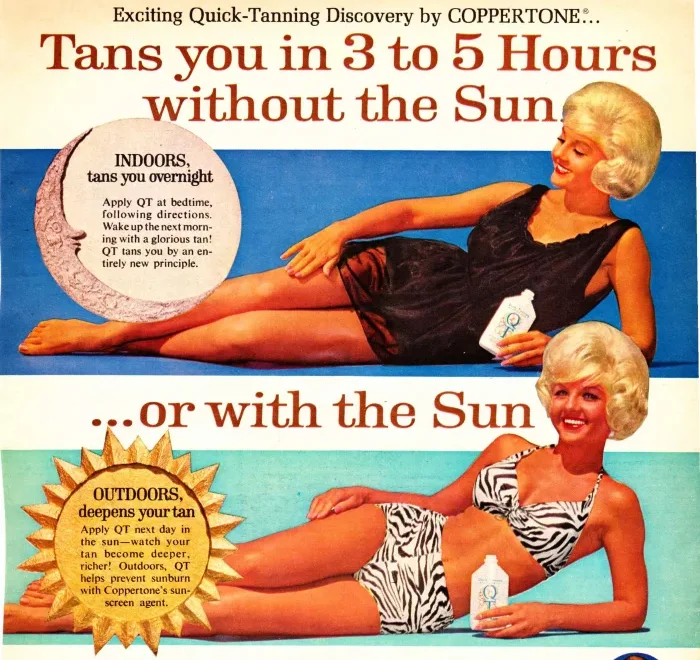
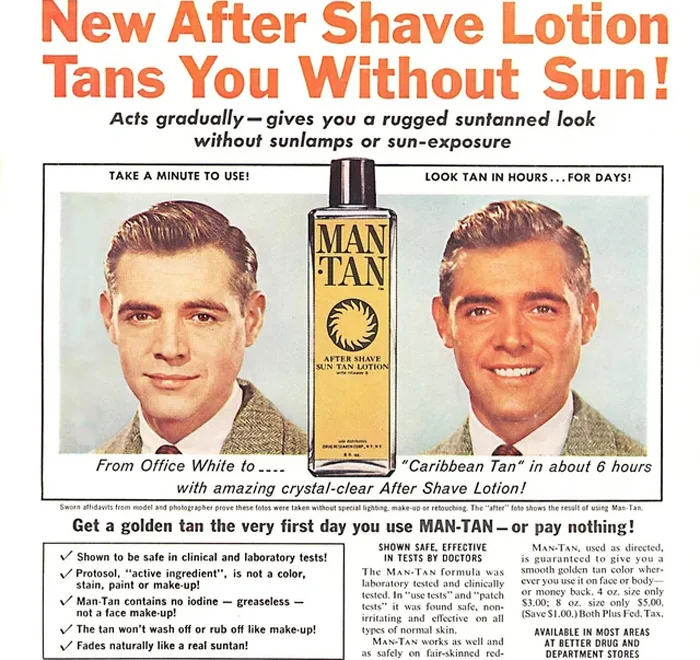
Following Dr. Wittgenstein's discoveries, the first commercial self-tanning products containing DHA were introduced to the market in the 1960s. The world's first DHA tanning product, Man-Tan, went on sale in the 1950s. It was aimed at men, but failed to take off because of unpredictable results. No two tans are identical because every skin type is different, particularly in terms of pH and hydration. Man-Tan could turn skin orange and tended to leave streaks, and it did not smell particularly good. Similarly, Coppertone launched the first “Quick Tan (QT)” product, which claimed to work indoors and outdoors, with a tan developing in four to five hours. These drawbacks stimulated research and innovation, leading to continuous improvements in formulas and application methods.
Estee Lauder to the Rescue
In the late 1990s, Estee Lauder noted in a patent that DHA in cream form remains on the surface of the skin, accumulating or clumping together. This results in a tan that does not look natural. Atomised droplets were then introduced as a way of applying DHA to the skin. When sprayed like paint, DHA can reach more cells, resulting in a much more natural-looking tan.
Spray Tanning
Then came automated self-tanning. Mystic Tan, the first consumer version, was launched in 1998 and provided a glow simply by standing in an automated machine that sprayed users from every angle. The method improved in 2003, when Jimmy Coco created the world's first mobile spray tanning kit, known as “The Bomb”. It helped him attract clients such as Heidi Klum, Victoria Beckham and Katy Perry, ushering in the era of celebrity spray tanning that we still see on red carpets today.